Opponent preparation
How to Prepare for a Chess Opponent Using Their Games
Good preparation is not an attempt to memorize a player's entire archive. It identifies the positions most likely to appear, checks where the evidence is reliable, and reduces the work to a plan you can remember at the board.
By Norbert Jakubiak · · 9 min read
Define the game before opening the data
Write down the expected color, time control, and date of the game. Preparation for a rapid game as White should not be driven by the opponent's bullet games as White. The question determines which evidence matters.
Choose a period that balances recency and sample size. Recent games deserve more weight because repertoires change. Older games become useful when the current sample is thin or when you want to test whether a choice is a long-term habit.
Find the repertoire you are likely to face
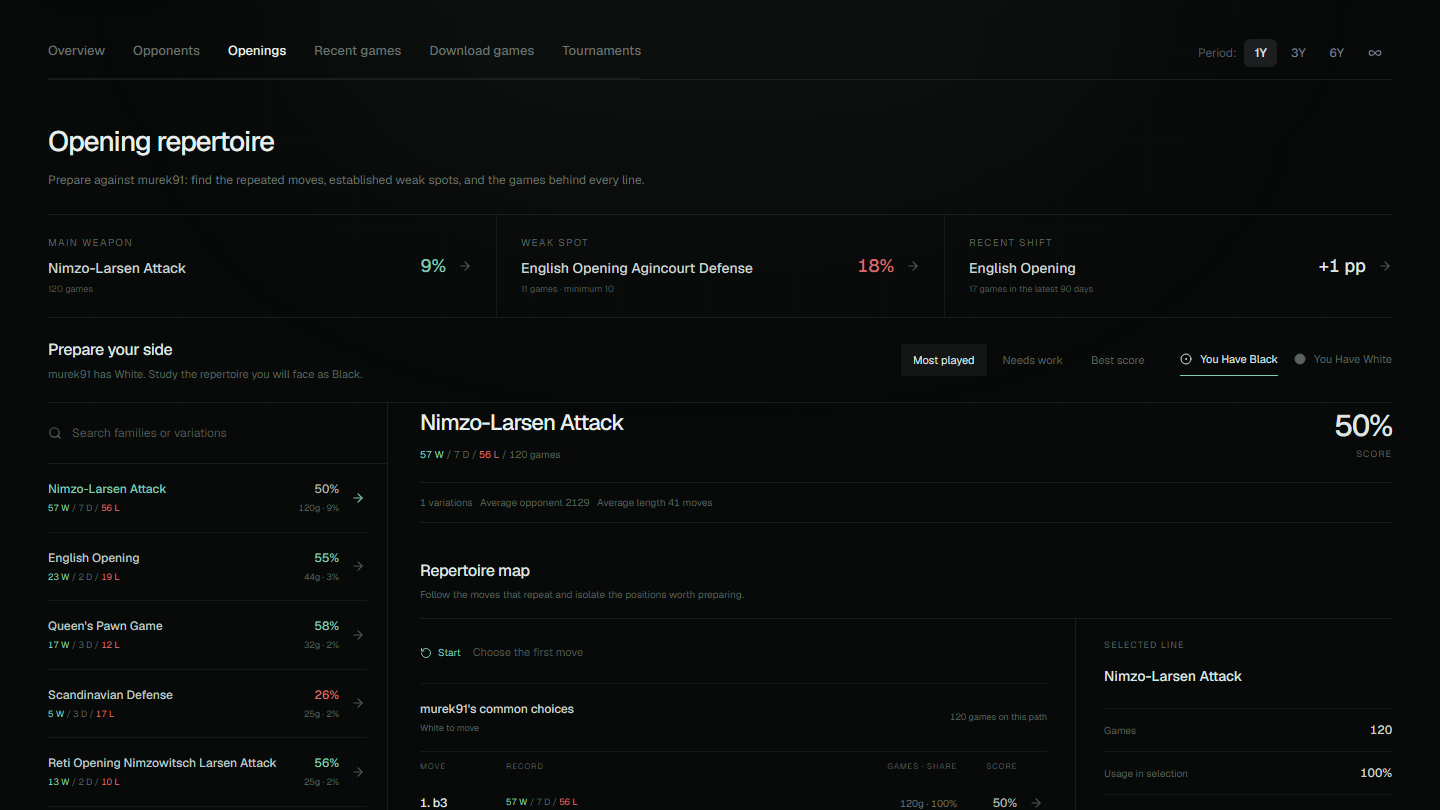
Select the side your opponent will play. Start in Most played and identify the opening families that account for a meaningful share of the relevant games. Then follow the repertoire map move by move to see which branches survive beyond the opening label.
Frequency is your probability layer. It does not tell you what move is best, but it tells you where preparation time has the highest chance of being useful. Keep one main branch and one fallback rather than building a wide tree you will not remember.
- Prioritize lines played recently and repeatedly.
- Notice transpositions that reach the same structure by another move order.
- Ignore rare experiments unless they appeared very recently.
- Keep the final shortlist small enough to review on a board.
Separate a weak score from a real weak spot
Switch to Needs work to find lines with poor results, then check the sample. An extreme score over two games is weak evidence. A modestly poor score across many recent games is more interesting, especially when the player repeatedly reaches the same middlegame.
Open the underlying losses and mark the first decision that you would want to test. The target may be an opening move, but it may also be a recurring plan, an early queen trade, a structural concession, or a time-pressure pattern.
Inspect representative games, not every game
Choose three to five examples from the shortlisted branch. Prefer opponents near your level and a similar time control. Include at least one win, because successful games show the plans the opponent understands and the positions they are trying to reach.
Use the board viewer to compare move orders and decision points. Record positions, not just notation. A board position with one sentence about the plan is easier to recall than a long sequence of memorized moves.
- One recent typical win.
- One recent typical loss.
- One game against a comparable opponent.
- One game that reaches the exact branch you plan to play.
Add form and head-to-head context
Overview shows whether the player is active and whether current results differ from their longer baseline. Opponents shows repeated matchups and shared history. These views can adjust your confidence in the opening evidence, but they should not replace it.
If you have played this opponent before, review those games first. Your shared history shows what they chose against you and which positions both of you were willing to repeat.
Turn the research into a one-page plan
Write the expected opening, the fallback, two positions to review, one tactical motif, and one practical reminder. Add links to the representative games so you can refresh the plan without repeating the entire search.
Stop when the plan is clear. Immediately before the game, confidence in a small number of familiar decisions is more valuable than another hour of broad browsing.