Getting started
How to Analyze Any Chess.com Player
A Chess.com profile gives you ratings and an archive. A useful player analysis goes further: it separates formats, tests patterns against real games, and ends with one decision you can act on.
By Norbert Jakubiak · · 8 min read
Start with the exact Chess.com username
Enter the public Chess.com username, not the display name. The username is the stable identifier in the Chess.com profile URL and avoids confusing players with similar names.
Chess Scanner combines available public profile data with the game history loaded for the selected period. A new, private, or inactive account will naturally produce a smaller sample, so the first question is always how much evidence is available.
Use Overview to establish context
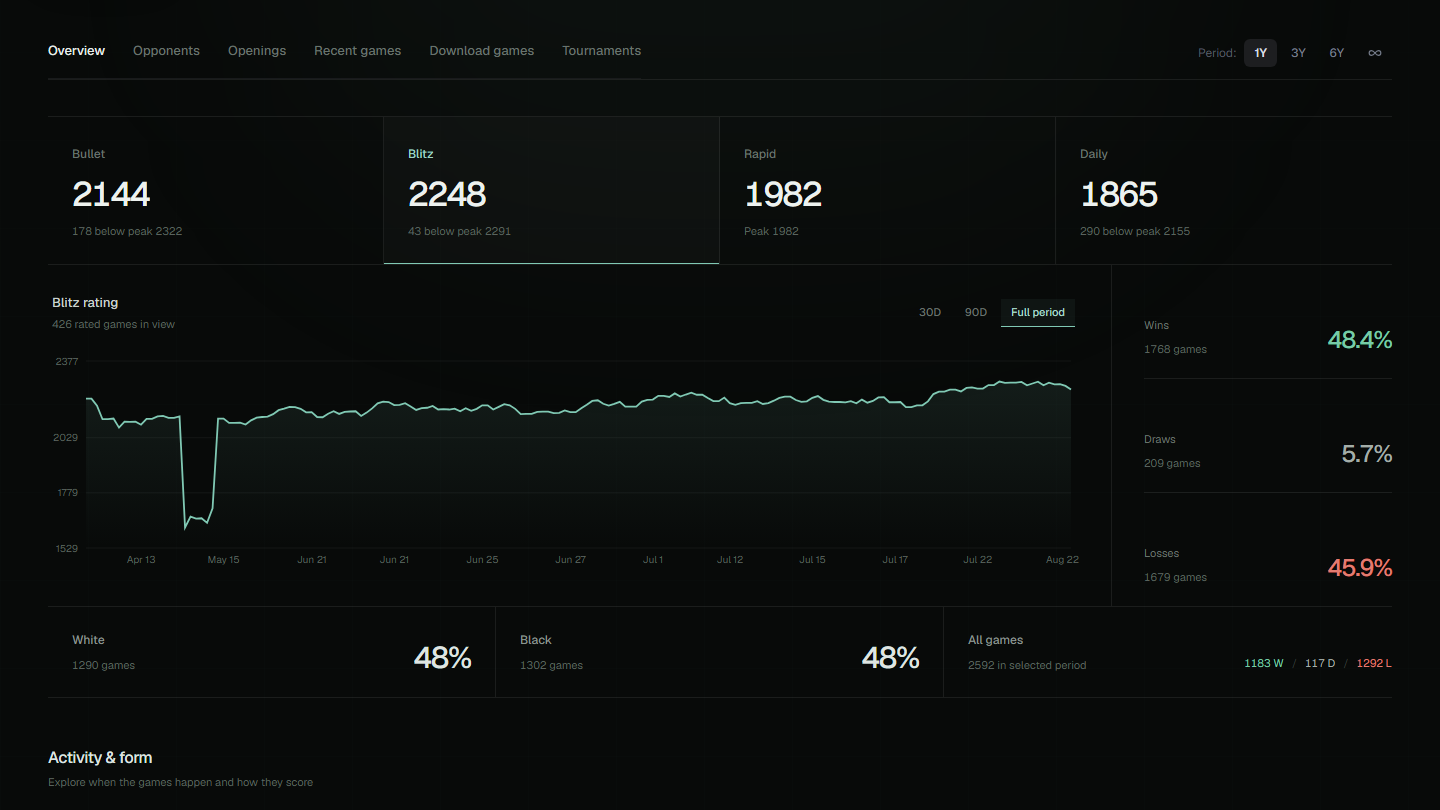
Begin with the four rating formats. Click the format you want to study, then read the rating line together with its peak, game count, result split, and period. This prevents a common error: describing a bullet streak as a general change in playing strength.
Next, scan activity and color performance. Activity tells you whether the evidence is current and whether the player is competing regularly. The White and Black split can reveal a direction worth investigating, but it is a prompt to open games, not a diagnosis by itself.
- Prefer a sustained direction over one dramatic spike.
- Treat a small sample as a question, not a finding.
- Compare White and Black only within the same format and period.
- Use recent activity to separate current form from old history.
Read the rating chart as a map
The chart shows where to investigate. A sharp fall, a long plateau, or a steady climb gives you a useful time window, but it does not explain the cause. Open the games around that point and look for changes in volume, openings, opponent strength, or repeated tactical errors.
If the line contains abrupt isolated drops, check whether they come from sparse archive data or a short return-to-play session. The shape is meaningful only when you know how many games created it.
Move from opening families to real positions
Openings organizes repeated choices into families and variations. Start with frequency to understand what the player actually reaches, then compare score and sample size. A rare line with one loss is less useful than a common branch that repeatedly creates the same uncomfortable position.
Use the repertoire map to follow the moves that recur. When a branch looks important, open the games behind it. Check whether the poor result came from the opening, a later tactical mistake, or a mismatch between the position and the player's preferred style.
- Most played tells you what is likely.
- Needs work highlights candidates for deeper review.
- Recent shift shows whether the repertoire is changing.
- The game list verifies what the percentages cannot explain.
Check opponents and recent games
The Opponents view adds matchup context. Repeated games against the same player can distort a period, while a strong head-to-head record may reveal familiarity rather than a universal strength. Open the opponent details to compare the record, formats, rating paths, and shared games.
Finish the evidence pass in Recent games. Select two or three representative examples: one typical win, one typical loss, and a game near the rating turning point. Watching those games on the board is where abstract patterns become chess decisions.
Leave with one training decision
A complete scan should end with a short conclusion and a next action. Review one recurring opening position, analyze two representative losses, prepare against a frequent opponent, or study the phase where the rating trend changed.
Do not collect every chart into a vague profile. Choose the smallest useful task that the evidence supports, complete it, and return later with a new question.