Opening preparation
How to Find Weaknesses in a Chess Opening Repertoire
An opening weakness is not a red percentage next to an ECO code. It is a position a player reaches often, handles less effectively than comparable positions, and is likely to face again.
By Norbert Jakubiak · · 10 min read
Begin with the side you will face
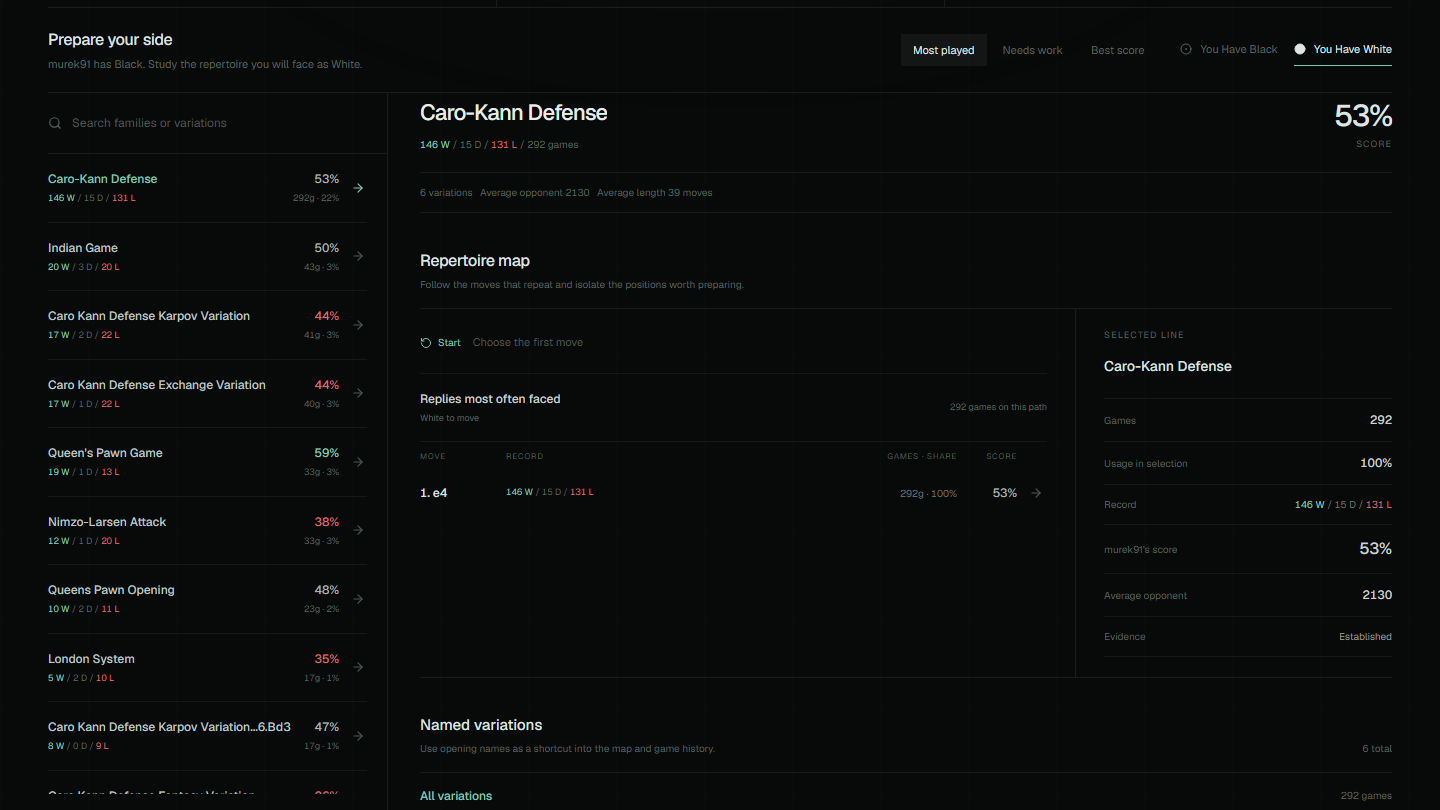
If you expect to play White, study the opponent's Black repertoire. If you expect Black, study their White repertoire. Mixing both colors creates a list of openings that cannot occur in the game you are preparing for.
Then choose the relevant time control and period. Blitz may reveal practical habits, while rapid games often give a clearer view of planned repertoire. Recent games show current choices, but a wider period helps when the sample is small.
Build the repertoire map by probability
Start with the first move families, then follow the branches that retain a meaningful share of games. A line played once is trivia. A line repeated across months is preparation material.
Transpositions matter. Two move orders may reach the same position, so the useful unit is often the resulting structure rather than the name shown in the game archive.
- Mark the branches that account for most relevant games.
- Give extra weight to choices repeated in the latest period.
- Merge move orders that reach the same position.
- Keep rare experiments outside the main preparation plan.
Judge weakness with three signals
A useful target combines frequency, a credible sample, and a result or decision pattern. Poor results across many games deserve attention. Poor results across two games deserve a note and more evidence.
Compare the candidate line with the player's other openings in the same format and period. The question is not whether 45 percent looks low in isolation. The question is whether this branch performs worse than their normal baseline and why.
Locate the first repeatable problem
Open representative wins and losses from the branch. Step through them until the games stop resembling each other. The last recurring position before they diverge is often the best place to begin deeper analysis.
Look for a repeated plan that arrives late, a pawn break that is missed, an uncomfortable trade, or a structure where time usage deteriorates. That is more actionable than memorizing that the player scores poorly in an opening family.
- Compare at least one win with two typical losses.
- Prefer opponents near the expected playing strength.
- Record the position and plan, not only the move sequence.
- Separate opening decisions from later tactical errors.
Turn the target into a board exercise
Place the recurring position on a board and write two candidate plans for your side. Use engine analysis only after you have explained the position in your own words. The goal is to recognize a decision, not to memorize a computer line without context.
Finish with one main continuation and one fallback. If the opponent varies earlier, your structural understanding should still help you navigate the position.
Know when the evidence is not enough
A changing repertoire, a long inactive period, or a tiny relevant sample can make a confident opening prediction impossible. Say so. A preparation plan with explicit uncertainty is stronger than a precise claim built on unrelated games.
In that case, prepare a sound structure you understand well and use the archive only to avoid obvious surprises.